
-
Menu
Tech specs
Eastern Bluebirds have become a somewhat common sight in the Eastern U.S. and in Central Ohio, where I spend part of the year. But that wasn’t the case 25 years ago, when harsh winters, the destruction of natural habitat, the harmful effect of pesticides, and competition with other birds who nest in the same tree cavities as bluebirds combined to make the Eastern Bluebird a rare sight.
The number of Eastern Bluebirds had declined almost 90 percent from populations recorded in the late 1950s and early 1960s. The significant decline led to the Eastern Bluebird being declared a rare species in the late 1970s.
The rebound of the Eastern Bluebird population can be credited to the efforts of wildlife enthusiasts who worked to create habitats attractive to the remaining birds. In 1978, the North American Bluebird Society was formed to encourage the installation of nest boxes. This extensive effort provided sufficient nesting locations for bluebirds as the species competes with other cavity nesters (swallows, chickadees, wrens, house sparrows, starlings) for nesting sites. The efforts were so successful that the Eastern Bluebird was removed from the rare species list in 1996.
I found this male Eastern Bluebird checking out a potential nesting site north of Columbus, Ohio, on an early April morning. The bird had located a knothole in a tree and I watched while it repeatedly entered and exited. The knothole had the added benefit of a branch from a neighboring tree that provided the Eastern Bluebird with a “front porch” — a place to perch without having to cling to tree bark around the knothole.
I usually see bluebirds competing with other cavity nesters for control of the many nesting boxes in local fields. It was nice to see this one going old school by finding a cavity in the wild.
Eastern Bluebirds typically have more than one brood each year — one in spring and a second in late summer. So there's a good chance hikers will encounter young bluebirds in fields for much of the year. The late summer nesting typically has less competition for suitable nesting sites since many of the other species of cavity dwellers breed only in the spring.
Bluebirds prefer to nest in open fields, meadows, hedges or gardens. Several metro parks in the Columbus area (like Sharon Woods Metro Park) have numerous nesting boxes in fields. The bluebirds can often be found perched on the boxes, on plants in the fields or on tree limbs adjacent to the fields.
The male bluebird is more colorful than the female, with deeper blue feathers on its head/back and a bright chestnut chest above a white belly. The female is more muted, with the blue feathers taking on more of a gray cast and the chestnut chest more subdued.
In recent years a growing number of Eastern Bluebirds have become year-round residents of Central Ohio in spite of the often harsh winter weather in the area. I’ve seen several bluebirds braving the snow during my winter treks through the parks.
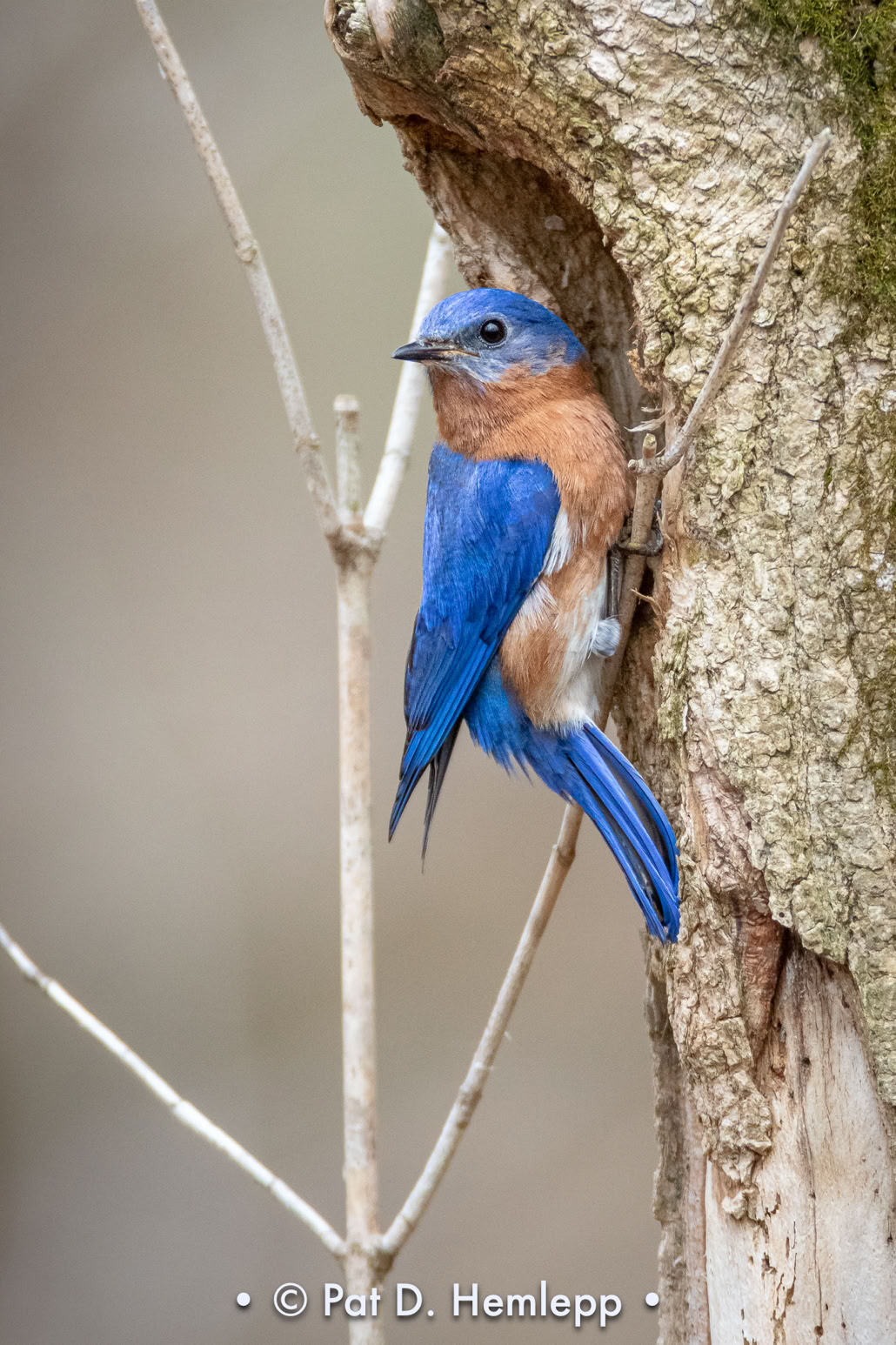
A male Eastern Bluebird looks around outside a potential nesting site in Sharon Woods Metro Park, Westerville, Ohio.