
-
Menu
-
Home
-
Photo of the week
-
Featured gallery
-
Favorites
-
Recent photographs
-
About
-
Contact
-
As always when shooting through glass, I put the lens hood of the telephoto zoom lens I was using that day close to — and perpendicular to — the glass to eliminate reflections of people passing by.
Every time I post a photo taken in a zoo, I make the same statement: I have more difficulty getting quality photos of animals in a zoo than I do in the wild.
It seems like it should be the other way around. After all, I know exactly where the animals are at a zoo. There are maps and signs showing where to find animals. Can't miss 'em. Just walk up to the pen and start shooting. Nothing to it.
Except there are often high fences to shoot through. Or glass walls. And crowds of people. And the animals tend to seek shelter far from the viewing areas.
This Malayan flying fox, a large bat, was hanging about 15 feet from me during a visit to the Columbus Zoo in Ohio, but there was a glass wall separating me from the bat. Thick glass makes it difficult to get a sharp photo. The glass acts as a diffuser, softening the features of the subject. And autofocus can be fooled by glass. Add the dirt and scratches to the equation and capturing a sharp photo becomes as much luck as skill.
As always when shooting through glass, I put the lens hood of the telephoto zoom lens I was using that day close to — and perpendicular to — the glass to eliminate reflections of people passing by. I set the camera to use a wide aperture to reduce the depth of field in an attempt to minimize the impact of any scratches or dirt on the glass. And I took a series of photos, refocusing between photos, to increase the chances that I’d get some shots with accurate focus.
In other words, I used the “law of averages” method of photography when shooting through glass. If you refocus frequently and take a lot of photos, there’s a chance one might be usable.
And this is the usable photo.
Malayan flying fox, one of the largest bat species in the world, with a wingspan of up to 5 feet. It features a dog-like or fox-like face. Found across Southeast Asia — primarily in Malaysia, Indonesia, Thailand, and the Philippines — its diet consists exclusively of fruit, nectar, and flowers. Unlike other bats, the flying fox lacks echolocation (the type of radar using sound waves to detect objects). The flying fox has sharp eyesight and a strong sense of smell it uses to navigate and find food.
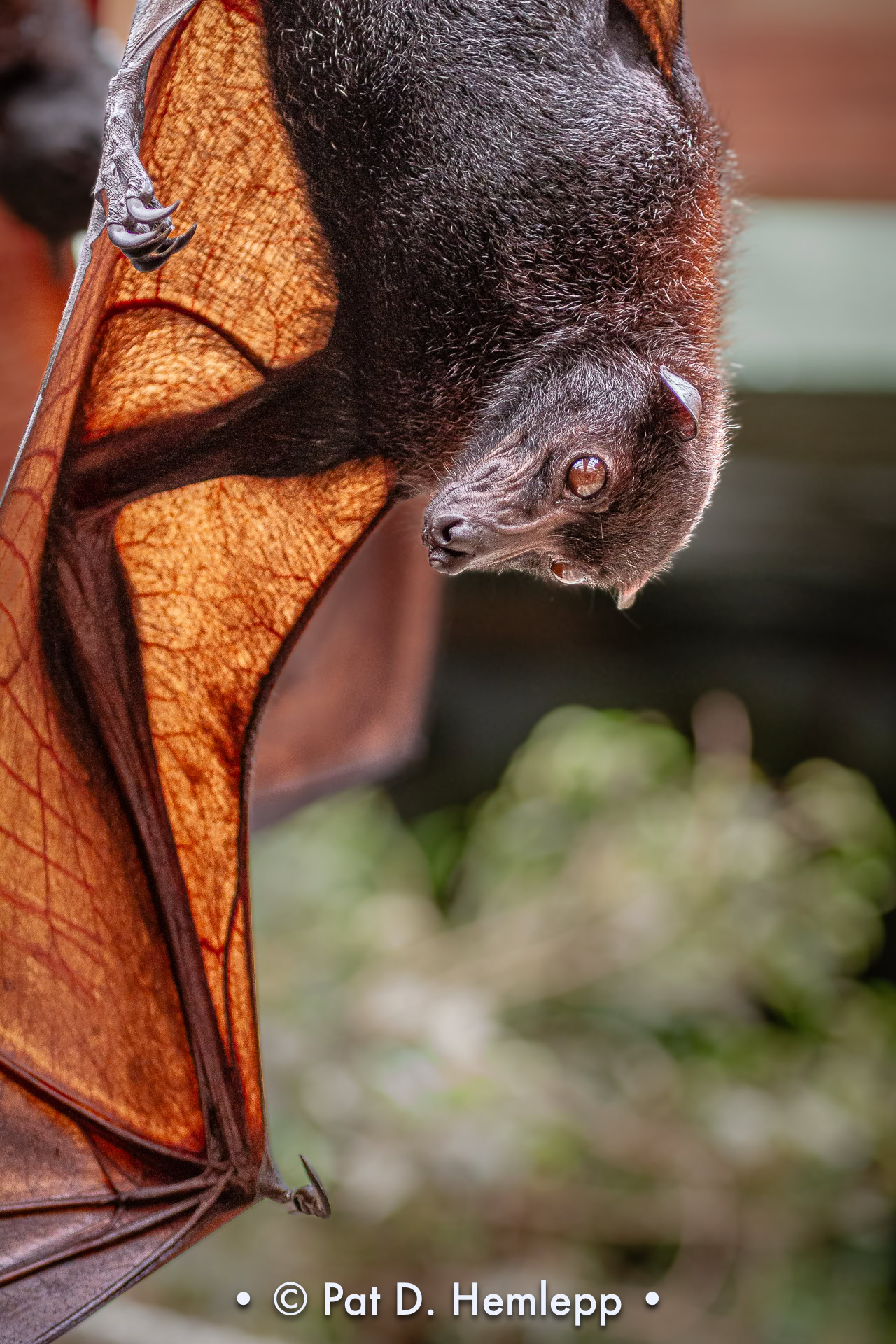
Malayan flying fox hanging, Columbus Zoo, Powell, Ohio.
Tech specs